-
Shop
- Adidas
- Advanced Technologies
- AI Skills
- AI Skills Mastery 2026 Collection
- Bathroom
- Best-Sellers
- Calvin Klein
- Car Accessories
- Confidence
- Dating & Social Skills
- Digital Resources
- AI & Technology
- Beauty
- Car Buying & Ownership
- Cozy Feast Collection
- Electronics & Technology
- Financial Education
- Hobbies
- Home Styling & Organization
- Kitchen & Recipes
- Mindset
- Online Business
- Parenting & Child Development
- Personal Style & Fashion
- Pet Lifestyle & Wellness
- Smart Life with AI
- Travel Planning
- Wellness
- Yoga & Fitness
- Education & Learning
- Family & Parenting
- Fashion
- Alexander McQueen
- Bags
- Bags & Wallets
- Balenciaga
- Belts
- Blazers
- Blouses & Shirts
- Bottega Veneta
- Brunello Cucinelli
- Burberry
- Chanel
- Chloé
- Dior
- Dolce & Gabbana
- Dresses
- Etro
- Fendi
- Gucci
- Hats & Hair Accessories
- Jacquemus
- Jewelry
- Jil Sander
- Keychains
- Kiton
- Luggage
- Luggage Bags
- Miu Miu
- Off-White
- Outerwear
- Prada
- Rick Owens
- Saint Laurent
- Scarves
- Shoes
- Socks & Tights
- Sunglasses
- The Row
- Tom Ford
- Valentino
- Valentino Garavani
- Versace
- Vivienne Westwood
- Watches
- Fashion Accessories
- Furniture
- Gadgets
- Health & Beauty
- Health & Wellness
- Home & Garden
- Home Decor
- Home Electronics
- Home Supplies
- Kids & Babies
- Kitchen
- Kitchen Best-Sellers
- Lighting
- Online Business for Beginners
- Patio, Lawn & Garden
- Personal Growth
- Pet Care
- Pet Supplies
- Pets
- Smart Amazon Shopping
- Smart Home Living Guides
- Sport & Outdoors
- Stress Relief & Relaxation
- Super Deals
- TikTok Growth & Monetization Mastery
- Travel
- Travel & Adventure
- Wealth
- Wealth Building
- Budgeting & Saving
- Cryptocurrency Investing
- Debt Management
- Entrepreneurship & Business Growth
- Family Finance & Budgeting
- Financial Independence
- Financial Mindset & Psychology
- Financial Planning
- Frugal Living & Expense Hacks
- Goal Setting
- High-Income Skills
- Investing Basics
- Leadership
- Motivation
- Networking & Mentorship
- Passive Income Strategies
- Real Estate Investing
- Side Hustles
- Stock Market Investing
- Popular
- Best deals
- Blog
Speak Up Daily: A 15-Min Checklist to Build Confidence
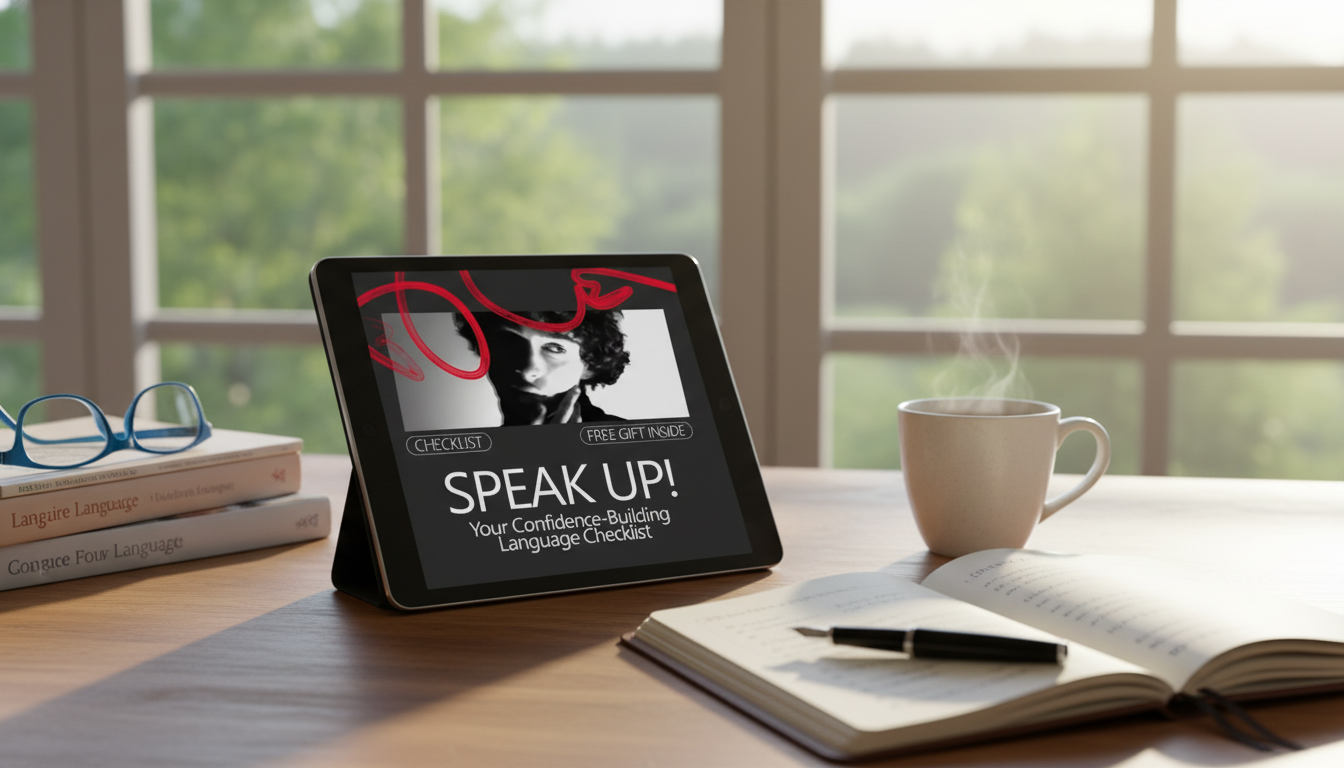
Speaking can feel like the hardest part of learning a language—not because of grammar, but because of nerves, perfectionism, and fear of sounding “wrong.” A simple checklist turns confidence into a daily habit: small, repeatable actions that reduce anxiety, build momentum, and make speaking feel normal. The goal is steady progress through low-pressure practice, a supportive mindset, and a clear plan that fits real life.
Why confidence drops when it’s time to speak
Confidence often dips the moment speaking becomes “real-time.” Unlike reading or listening, conversation doesn’t pause while you search for the perfect word.
- Real-time pressure leaves less room to think first, which can trigger stress and mental blanks.
- Perfectionism raises the stakes; mistakes start to feel like failure instead of feedback.
- Low output exposure (lots of input, little speaking) makes conversation feel unfamiliar and risky.
- Identity pressure (“I should be better by now”) can block experimentation—the exact thing that builds fluency.
One helpful frame is self-efficacy: the belief that you can succeed at a task. Small, repeatable speaking wins build that belief over time (see the APA definition of self-efficacy).
The “Speak Up” mindset: progress-friendly rules for everyday practice
- Clarity over correctness: aim to be understood first, then refine accuracy over time.
- Use a mistake budget: pick a daily number of “allowed mistakes” so errors feel normal, not catastrophic.
- Process goals beat outcome goals: replace “sound fluent” with “speak for 3 minutes today.”
- Reframe nerves as energy: use a quick physical cue (exhale, shoulders down) to release tension before speaking.
Mindset shifts that make speaking easier
| Stuck thought | More helpful replacement | 1-minute action |
|---|---|---|
| If I make mistakes, I look stupid. | Mistakes prove practice is happening. | Say one sentence anyway, then continue. |
| I need the perfect word. | A simpler word is better than silence. | Paraphrase using words already known. |
| My accent is embarrassing. | An accent is normal; clarity improves with repetition. | Slow down and emphasize key words. |
| I don’t know enough yet. | Speaking grows the knowledge needed. | Use a fixed script (intro, opinion, question). |
A daily speaking routine that builds confidence in 10–15 minutes
The most reliable way to feel less anxious is to make speaking more ordinary. This compact routine keeps the barrier to entry low while still creating real progress.
- Minute 1: Warm-up out loud (numbers, days, a short tongue-twister, or a familiar phrase set).
- Minutes 2–5: Micro-monologue (describe your day, summarize a video, explain a simple opinion).
- Minutes 6–10: Interaction (voice note to a partner, AI conversation, a short tutor snippet, or shadowing with pauses to respond).
- Minutes 11–15: Review loop (note 2 useful phrases + 1 pronunciation point; repeat once with improvement).
- Keep it consistent: same time, same trigger (after coffee, after commute, after dinner) to reduce decision fatigue.
If you want a few more proven speaking ideas, the British Council’s speaking practice tips are a practical reference: Tips for speaking in English.
A confidence ladder: start safe, then raise the stakes
Confidence builds best in steps. The goal is not to “jump into deep water,” but to climb from low-pressure speaking to real-life moments without overwhelming your nervous system.
- Level 1 (private): speak to yourself, record a voice memo, or read aloud with expression.
- Level 2 (semi-private): send a short voice message or practice with a supportive partner who won’t interrupt.
- Level 3 (structured): book a short lesson, join a guided speaking group, or use prompts that limit topic complexity.
- Level 4 (real-life): ask for directions, place a simple order, or make a short phone call with a script.
- Repeatable situations: use the same café, the same small-talk questions, and the same greetings to build automaticity.
Example weekly ladder (repeat weekly, increase difficulty slowly)
| Day | Speaking task | Pressure level | Win condition |
|---|---|---|---|
| Mon | 2-minute self-introduction recording | Low | Record without stopping |
| Tue | Describe a photo for 3 minutes | Low | Use 5 linking words (and/but/because/then/so) |
| Wed | Send one 30–60s voice note | Medium | Send even if imperfect |
| Thu | Role-play a common situation (ordering, appointments) | Medium | Complete the script once |
| Fri | 5–10 minute conversation or tutor session | Higher | Ask 2 questions |
| Sat | Real-world micro-task (greeting, small request) | Higher | Finish the interaction politely |
| Sun | Review + re-record Monday task | Low | Notice 1 improvement |
Scripts that reduce panic and keep conversations moving
When nerves spike, scripts prevent the “blank-out” moment. Keep them short, practice them frequently, and reuse them until they’re automatic.
- Stall phrases: “Let me think,” “How do you say…?” “One second.”
- Three-part opinion template: statement → reason → example (fast, repeatable, flexible).
- Repair phrases: “Can you repeat that?” “Did you mean…?” “I’m not sure I understood.”
- Question habit: curiosity shifts attention away from self-consciousness and onto the conversation.
For a quick reference on how “speak up” is commonly used in English, the Cambridge entry is clear: “speak up” meaning.
Track progress without overthinking
Printable support: a checklist that removes daily friction
- For a plug-and-play routine, try Speak Up! Your Confidence-Building Language Checklist (digital download).
- If phone scrolling is stealing your best energy, pair speaking practice with a calmer start using The No-Phone Morning Ritual Checklist: reset your mind before you scroll.
FAQ
When people say “speak up”?
It commonly means to talk louder or more clearly so others can hear you. It can also mean to share your opinion or say something important, like speaking up in a meeting when you disagree or need to clarify a point.
How do you use speak up in a sentence?
Examples: “Could you speak up? I can’t hear you.” and “She decided to speak up about the problem instead of staying quiet.” Both are everyday uses—one about volume/clarity, the other about expressing a view.
Recommended for you



Grow Eyelashes Naturally in 3 Days: What Works Fast
May 22, 2026













Leave a comment